Brownfield vs Greenfield: Which Is Right for Your Industrial Warehouse Project?
May 11, 2026
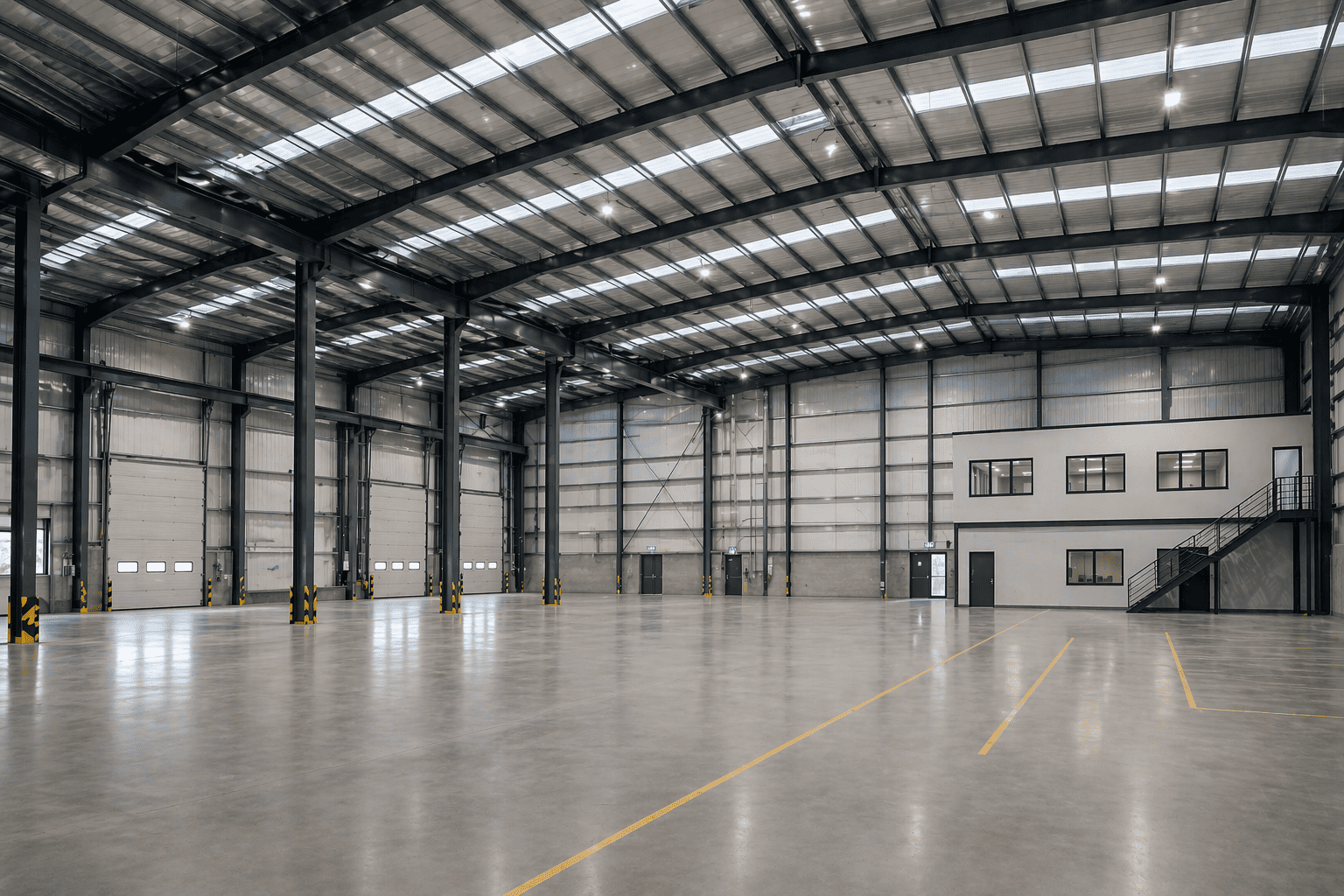
In choosing a site, every other element of the project is set, including the cost of acquisition, the time required to complete the project, planning risks, and ultimately, the structure you will create. If the choice is incorrect, the rest of the project will be spent recovering from an error in judgment that was made within days of commencing.
Guides typically depict the selection between brownfield and greenfield development as a simple matter of economics. Acquisition costs are lower when buying a brownfield site than a greenfield site. However, there is greater difficulty associated with constructing on a brownfield site. Conversely, while obtaining the necessary approvals to develop a greenfield site is significantly more difficult, once those approvals are obtained, construction on such a site should be relatively easier. This oversimplifies the situation. The economic realities depend on numerous factors, including the type of facility being constructed, who it is being built for, and the level of risk the developer can absorb before the project's viability is compromised.
Ultimately, this guide provides insight into each option based on our experiences working on "live" projects.
What does the terminology really mean?
Brownfield describes land which has previously been developed. This includes: old factories, abandoned warehouses, vacant retail park space, and abandoned industrial estates. There is typically history (and thus potentially structural integrity) remaining in the area; often, environmental contamination exists beneath the earth; utilities (such as electricity, gas, telephone, etc.) and access (including roads) are present.
Greenfield describes land which has never been developed. Examples include agricultural land, open countryside, or vacant parcels of land adjacent to urbanised areas. In addition to having no existing structures on the parcel, there are no structures to demolish; the parcel will therefore lack the typical supporting infrastructure (roads, power, etc.) and will face significant opposition to development due to zoning restrictions.
Under current UK law (National Planning Policy Framework), local government authorities are required to favour the use of brownfield sites over greenfield sites. Since this policy affects whether or not you will receive approval to proceed with your proposed development, it is important.
The advantages of developing on a brownfield site
Obtaining permits for brownfield development is generally easier than for greenfield development. Governments are continually attempting to meet their respective obligations regarding meeting residential and commercial land requirements while limiting their exposure to criticism (by avoiding the release of protected greenbelt or rural land). As a result of these pressures, applications for industrial use on brownfield properties that utilise land currently designated for employment purposes are typically viewed as a "least resistant" alternative. Approval times are shorter. Rejection rates are lower.
Existing infrastructure (e.g., roads, power supplies, water mains, sewers, telecommunications) is present on virtually all brownfield sites. With a new development located on a greenfield site, you would likely be responsible for paying to connect a high-voltage transmission line across multiple fields — an expense you cannot pass along to a utility company.
Logistical locations are typically better for transportation on brownfield sites. These locations were previously home to industry (i.e., close proximity to major highways, seaports, rail freight terminals and labour pools), making it easier for companies using the facilities to obtain adequate logistical support. Logistically comparable greenfield sites are extremely hard to find and therefore expensive.
The purchase price for brownfield land is typically lower. Brownfield sites that are contaminated or otherwise limited in some way sell at a reduced value. When you consider that you may be able to offset part of the remediation cost against the savings realised in purchasing the land at a discounted rate, you can see why this could become attractive.
While the disadvantages of developing on a brownfield site are certainly valid; they do require consideration during the budgeting phase:
-Contamination. Development on former industrial sites requires dealing with chemicals (hydrocarbons), toxic elements (heavy metals), asbestos, and/or contaminated fill material. A Phase I desktop study represents the minimum effort required before initiating Phase II invasive investigations. Costs associated with remediation can range from tens of thousands of dollars to millions.
-Demolition. Structures that existed at the time of purchase must be demolished. The costs associated with removing asbestos or hazardous materials from those structures increase rapidly. Additionally, if any portion of the structures is listed or locally significant, demolition may be completely prohibited.
-Ground conditions. Depending upon previous activities on the property (made ground, past foundation activity, buried storage tanks, and unidentified underground services), piling costs increase and so does programmatic risk.
-Hidden constraints. While not necessarily hidden in plain sight; restrictive covenants; rights of light; neighbor disputes related to party walls with neighboring industrial tenants; and transferring liability for contamination present opportunities for attorneys to review prior to entering into an agreement of sale.
What the case is for Greenfield
Greenfield sites offer several advantages in terms of delivery speed. A greenfield site has none of the risks associated with demolishing contaminated buildings or dealing with the uncertainties beneath a brownfield site. Therefore, on a greenfield site, you will typically begin groundworks sooner, and they tend to move forward much faster. If you are a developer or owner/occupier with a hard-and-fast deadline, such as a lease expiration date, a contractual commencement date, or an operational ramp-up, the importance of delivering your project quickly is far greater than achieving the lowest possible headline cost.
Greater design flexibility. When developing a greenfield site, you are free to orient your building to take advantage of its best yard depth, dock door positions, HGV circulation patterns, and potential future expansion opportunities. In contrast, many brownfield sites require compromises due to existing boundaries, retained structures, or contamination hotspots.
Less risk associated with construction. Greenfield projects typically contain fewer unknowns than their brownfield counterparts. This results in a lower premium charged by contractors to cover their perceived risk exposure. As a result, the prices bidders pay for a greenfield project are generally lower.
Larger footprint options available. The majority of large-format distribution centres -- those over 500,000 square feet -- are located on either greenfield sites or other designated areas for strategic employment for obvious reasons. While it is rare to find a brownfield site suitable for large-footprint development due to size restrictions, poor yard depth, and/or limited space surrounding the property, it is even rarer to find one that meets today’s modern logistics requirements.
But there are also disadvantages to choosing greenfield:
More difficult and longer-term planning process. While some objections may arise against proposals for greenfield sites, especially if they are proposed within a Green Belt or Area of Outstanding Natural Beauty, these types of sites generally generate more objections than brownfield sites. Objections are likely to include concerns about highways, ecology, landscape impacts, and the loss of agricultural land. An application for permission to develop a greenfield site may ultimately be refused, leading to an appeal which would add a further twelve months to the overall duration of the project.
Additional infrastructure costs. Depending upon the specific nature of your project, additional infrastructure costs, including utility connection fees, highway improvement costs and Section 278/106 contributions, may apply. Such costs can be significant and should be considered carefully during the initial feasibility study phase. It is common for the estimated cost of these additional infrastructure costs to be significantly underestimated at the outset of the project.
Ecological constraints. Similar to the issue of contaminated soil found at brownfield sites, ecological constraints at greenfield sites may prevent or limit development due to factors such as great crested newt habitats, bat roosts, badger setts, and protected hedgerow trees. Nutrient neutrality rules in certain catchment areas may also affect the viability of your proposal. Additionally, biodiversity net gain is now mandatory and will add further costs to your development.
Higher cost per unit area. Land costs per square meter in strategic employment zones within high-demand logistics corridors tend to be very high. Unless you find a low-cost field in an appropriate location, you cannot expect to acquire a greenfield site at a very low cost.
How to make decisions
While each development project has its unique characteristics and therefore requires individualised consideration, five basic questions will help to determine whether greenfield or brownfield is the better choice for most projects.
1. What type of facility will you be building, and what size will it be?
If you plan to build a sub-100,000 sqft urban logistics centre or a last-mile facility, it is highly unlikely that a greenfield site will be required -- instead, choose a brownfield site. However, if you plan to build a large-format regional distribution centre (250,000 sq ft+) that will serve multiple customers across different regions and/or states, it is highly probable that only a greenfield site or a strategic employment zone will meet your needs.
2. Is your project deadline firm?
In addition to determining the suitability of greenfield versus brownfield based on the type and size of the facility you wish to build, it is essential to consider your project timeline. If you have a fixed end date (e.g., a lease expires), it is likely you will need to opt for greenfield rather than brownfield, as the former offers less uncertainty regarding development timelines. Conversely, if your business model can accommodate delays and/or unexpected setbacks (e.g., the discovery of contamination) associated with working on a brownfield site, then it may offer greater opportunity for successful development.
3. Are you willing to accept higher levels of risk?
As mentioned previously, working on a brownfield site inherently involves accepting a level of risk from both known and unknown environmental contaminants. Conversely, while some level of risk exposure is always present when working on a greenfield site (e.g., weather-related delays), it is generally lower than that on a brownfield site. If your company prefers to avoid taking unnecessary risks and/or cannot afford to lose money due to unforeseen circumstances resulting from working on a contaminated site, then opting for greenfield is recommended.
4. Where must your facility(s) be located?
Consideration of your customer base's requirements, labour market demands, proximity to major transportation routes (including highways/motorways), etc., should occur early in the site selection process. By identifying and prioritising your absolute needs (location-wise), it will likely dictate whether greenfield or brownfield is viable.
5. What is the local planning authority's attitude towards development in general and specifically regarding the type of facility(s) you wish to build?
Reading and understanding local plans prior to pursuing a particular greenfield site is an inexpensive form of research, but one that may prove critical in avoiding costly mistakes down the line. Similarly, reviewing past precedent cases involving similar facilities in nearby areas will help you understand the likelihood of approval and potential constraints (e.g., ecological).
WHAT WE SEE ON LIVE PROJECTS
Clients who clearly identify their constraints before viewing potential development sites will typically receive the clearest and cleanest decision on whether they can proceed. Clients who become enamoured with a specific development site and then attempt to adjust their financial expectations to accommodate it will usually experience the most challenging and messy process.
In terms of costs, on both brownfield and greenfield sites, the largest cost typically associated with redevelopment is remedial action (remediation) – and the costs of this type of remediation can be highly variable. As such, intrusive site investigations prior to exchanging contracts are typically the best investment of time and money that a client can undertake.
As previously stated, the typical timelines for approvals for new developments (greenfield) can vary significantly depending on factors, including but not limited to local authority approval processes, appeal rights, and required Environmental Impact Assessments (EIA). In general, clients should anticipate a minimum of 12 months before approval is granted once an application has been submitted.
That being said, each method works as well as the other method. However, both methods will fail if the incorrect method is selected based solely on the wrong reason.
THE SHORT VERSION
Brownfield sites are best suited for smaller to medium-sized urban locations, which require a mid-range development budget to purchase land with known ground risks. Conversely, larger-format greenfield development opportunities with deadlines are better served by a large budget and significant upfront planning to achieve design flexibility and constructability certainty.
Ultimately, choosing the correct option for your project will depend on how you wish to optimise your goals. First, determine what you want to prioritise. Once that determination is made, the site selection process will follow.